I received some comments over my blog from a friend. I quote it as follows:
I read one article of your blog named as define your strategy ...., I noticed that your wrote such sentences:
A good strategy should be articulated in a manner that every employee understands it, aligns with it and acts on it. In essence, a strategy should have three critical components, objective, scope and advantage.
I have some different views towards this: in my view, strategy is a result that got from very carefully analyzing a company's objectives ( or can be said as mission) combined with a company's self-resource and industry environment such as competitor, supplier, buyer and so. The result can be thought as code of business action.
The same thing seems as happened to scope and advantages. Unquote
And my counter comments would be
Probably we hold different definition of strategy thereof arrives at different conclusion.
The industrial environment analysis and internal resource evaluation are necessary, and they are useful when you try to figure out the advantage of your company (the advanage I defined in my article is that something you do different and where you strength lies on).
My point is that strategy should be on the top of company's operations. it is palpable and it put everyone marching in lockstep toward the same direction. whereas nowadays, many many strategy formulation becomes too dynamic and unstable, a company's strtegy could be re-defined every year. The arguement is that strategy should follow the path of market and the market is always dynamic. I don't agree so. I think this ever-changing strategy symptom either comes from the illusion of self-assessment or from the wrong judgement of the industry.
At tactical level, company has many options to adapt and fine-tune its operation. But at strategical level, company should hold one core strategy that could be existing for long. As I mentioned in my article, a strategy is a direction to guide, a magnet to unite. If it could not keep stable, the momentum toward the vision/mission will be scattered, then the company's performance will be tattered.
Wednesday, April 23, 2008


Tuesday, April 22, 2008
Define your strategy in a palpable way
Tell you a secret, when you ask the CEOs to describle their company’s strategy in less than 35 words, most probably they will get stumbled. If you raise the question to their employees, most of them will have no clue to answer it. Although strategy might be the most frequently used word in the buisness sphere, it also might be the most obscure concept to be communicated.
To put one organization in a nutshell, we see the hierchies like the following:
Mission: Why we exist.
Vision: What we want to be.
Value: What we believe in and how things are done here.
Then Strategy.
Mission and vision of the company can be very broad concepts and not specific. However, most of the companies fall into the trap to define their strategy in the same manner, like we want to privide xxxx in a cost-efficient way to add value for our customer. This kind of out-of-touch strategy could stand for anybody, so what is good for?
A good strategy should be articulated in a manner that every employee understands it, aligns with it and acts on it. In essence, a strategy should have three critical components, objective, sope and advantage.
Objective
Objective gives a direction and a goal to realize. It must be specific, measurable and in a time frame. Like We would be the market leader of ABC before year 2015 with market share over 40%.
An unclearly defined objective will lose people’s attention and focus, not mention the sense of urgency.
Scope
In what region and in what area, vertically and horizontally speaking, the business should compete and grow. No company can excel in every business and with a clearly stated scope, every employees knows what business should take and what shouldn’t. So the company’s resource can be concentrated on the core business and set on the right path toward to the objective.
Advantage
Advange is the company’s distinct (distinct here means something you do differently. I truly disbelieve the copy of buisness model because any built-in model in a business has thousands of factors at the back to buttress it) strenth to propel and grow its business. This is the power of the company can wield to thrive in the market and fend off competitors. It is something no one can do better than you and something you can always count on to hit your objective.
If employees are likened to a handful of pins, when you throw them on one paper, the pins will point to different direction. But if you place a magnet near them, magically all the pin will point toward the same direction. That is also a clearly defined strategy would do. CEOs should wear a elevator strategy statement in their sleeves and communite it rentlessly to the employees. When this is done, the success is just around the corner.
To put one organization in a nutshell, we see the hierchies like the following:
Mission: Why we exist.
Vision: What we want to be.
Value: What we believe in and how things are done here.
Then Strategy.
Mission and vision of the company can be very broad concepts and not specific. However, most of the companies fall into the trap to define their strategy in the same manner, like we want to privide xxxx in a cost-efficient way to add value for our customer. This kind of out-of-touch strategy could stand for anybody, so what is good for?
A good strategy should be articulated in a manner that every employee understands it, aligns with it and acts on it. In essence, a strategy should have three critical components, objective, sope and advantage.
Objective
Objective gives a direction and a goal to realize. It must be specific, measurable and in a time frame. Like We would be the market leader of ABC before year 2015 with market share over 40%.
An unclearly defined objective will lose people’s attention and focus, not mention the sense of urgency.
Scope
In what region and in what area, vertically and horizontally speaking, the business should compete and grow. No company can excel in every business and with a clearly stated scope, every employees knows what business should take and what shouldn’t. So the company’s resource can be concentrated on the core business and set on the right path toward to the objective.
Advantage
Advange is the company’s distinct (distinct here means something you do differently. I truly disbelieve the copy of buisness model because any built-in model in a business has thousands of factors at the back to buttress it) strenth to propel and grow its business. This is the power of the company can wield to thrive in the market and fend off competitors. It is something no one can do better than you and something you can always count on to hit your objective.
If employees are likened to a handful of pins, when you throw them on one paper, the pins will point to different direction. But if you place a magnet near them, magically all the pin will point toward the same direction. That is also a clearly defined strategy would do. CEOs should wear a elevator strategy statement in their sleeves and communite it rentlessly to the employees. When this is done, the success is just around the corner.
Tuesday, April 8, 2008
Greenspan defends his legacy.
Once it appeared that Greenspan wrapped up his legendary career when his autobiography “the age of turbulence” published. Whereas now the ripple effect of the subprime crisis now second-guessed his previous shing 18 years as the chairman of federal reserve bank.
(Quoted from WSJ)
The prevailing view among critics faults Mr. Greenspan on two main counts
First, they say, his Fed lowered rates too much from 2001 to 2003 to cushion the economy from the bursting dotcom bubble. Then it took too long to raise them again. Low rates fueled mortgage borrowing, driving home prices to unsustainable heights.
Second, they say, the Fed was lax in its regulatory role. The central bank failed to press for stiffer rules for underwriting mortgages to people who ultimately couldn't afford them, they say. Also, they say, the Fed failed to anticipate banks' exposure to risky home buyers, leaving them with too little capital to absorb the eventual losses on those mortgages.
(Unquote)
I don’t want to judge who is wrong and who is right here. However, what rankles me is that whenever there is a trobule, some people (especially people always speak more than do) will play the blame game and ride on the critics. Hindsight is easy to pick but what these guys were doing when the decision was made back then. What makes me even furious is that many Greenspan’s peers now are also pouring their anti-Greenspan rhetorics. The question is why they didn’t not use their wisdom to challenge Greenspan back then ?.
Greenspan says “I was praised for things I didn't do, I am now being blamed for things that I didn't do." Even the agruement is right, Greenspan did lax to make those decision who probably led to this credit crisis. But who can gurantee that if Grennspan proposed something else, the economic condition will be better rather than worse?
Greenspan endorses laissez-faire regulatory oversight. I agree with him. I don’t believe heavy-handed government relation can eradiate financial or economic risks, if not make them higher. Market has its own self-correction mechanism, which is beyond human-being’s meddling. The history proves it in the past, and it will do now and in the future. What government should do is to ensure the play in the market is compliant with the rule.
(Quoted from WSJ)
The prevailing view among critics faults Mr. Greenspan on two main counts
First, they say, his Fed lowered rates too much from 2001 to 2003 to cushion the economy from the bursting dotcom bubble. Then it took too long to raise them again. Low rates fueled mortgage borrowing, driving home prices to unsustainable heights.
Second, they say, the Fed was lax in its regulatory role. The central bank failed to press for stiffer rules for underwriting mortgages to people who ultimately couldn't afford them, they say. Also, they say, the Fed failed to anticipate banks' exposure to risky home buyers, leaving them with too little capital to absorb the eventual losses on those mortgages.
(Unquote)
I don’t want to judge who is wrong and who is right here. However, what rankles me is that whenever there is a trobule, some people (especially people always speak more than do) will play the blame game and ride on the critics. Hindsight is easy to pick but what these guys were doing when the decision was made back then. What makes me even furious is that many Greenspan’s peers now are also pouring their anti-Greenspan rhetorics. The question is why they didn’t not use their wisdom to challenge Greenspan back then ?.
Greenspan says “I was praised for things I didn't do, I am now being blamed for things that I didn't do." Even the agruement is right, Greenspan did lax to make those decision who probably led to this credit crisis. But who can gurantee that if Grennspan proposed something else, the economic condition will be better rather than worse?
Greenspan endorses laissez-faire regulatory oversight. I agree with him. I don’t believe heavy-handed government relation can eradiate financial or economic risks, if not make them higher. Market has its own self-correction mechanism, which is beyond human-being’s meddling. The history proves it in the past, and it will do now and in the future. What government should do is to ensure the play in the market is compliant with the rule.
Sunday, March 30, 2008
Boeing takes schadenfreude back on itself
From Wall Street Journal, Boeing is scrambling to solve its own delay problem for its new dreamline 787. The memory of the delay of Aribus Jumbo A380 is still fresh. And once cheering furtively, Boeing has to swallow the same bitter pill by itself.
Boeing took a different strategy to develop its new airplane model. In short, it spread billions of dollars in development costs among a large number of suppliers, while also streamling its own manufacturing. But the web of suppliers crisscrossing the globe has contributed to several delays for the twin-aisle aircraft, hitting Boeing's share price and stirring concern among customers.
Boeing, in its new bid to get the 787 Dreamliner back on track, said Friday that it will buy out Vought Aircraft Industries Inc.'s interest in an assembly plant in North Charleston, S.C. The facility, called Global Aeronautica LLC, is a joint venture between Vought and Italy's Alenia Aeronautica.
Dallas-based Vought is a key player in Boeing's attempt to reinvent its production process for the 787 by giving more responsibility to suppliers who design, produce and integrate large sections of the jet. In this case, Vought and Alenia join large sections of the jetliner together before they are shipped to the Seattle area for final assembly.
Some suppliers, including Vought, have struggled with the new responsibilities, contributing to chronic delays in the 787 production process. Boeing is trying to overcome those problems by taking a direct stake in the assembly plant.
The fiasco hitting both Boeing and Airbus reminds me the other giant project stumbling occurred in the Heathrow Airport expansion project and others. It appears to me that the mistakes seems to be inavoidable when the size of the project becomes large. It is like the more complicate the machine is, the easier it will malfunction.
The lessons have been learned:
1.Never make a promise when the uncertainty is too high. Remember, the forecase to the furture could never be correct.
2.Be wary of your innovative idea bears potential risks that will bite at later stage
3.Always do what-if analysis in the project planning. Having a plan B never hurt you.
4.When the schedule is slipping, don’t expect the problem would solve by itself. Jump over it immediately and sort it out before it festers
Boeing took a different strategy to develop its new airplane model. In short, it spread billions of dollars in development costs among a large number of suppliers, while also streamling its own manufacturing. But the web of suppliers crisscrossing the globe has contributed to several delays for the twin-aisle aircraft, hitting Boeing's share price and stirring concern among customers.
Boeing, in its new bid to get the 787 Dreamliner back on track, said Friday that it will buy out Vought Aircraft Industries Inc.'s interest in an assembly plant in North Charleston, S.C. The facility, called Global Aeronautica LLC, is a joint venture between Vought and Italy's Alenia Aeronautica.
Dallas-based Vought is a key player in Boeing's attempt to reinvent its production process for the 787 by giving more responsibility to suppliers who design, produce and integrate large sections of the jet. In this case, Vought and Alenia join large sections of the jetliner together before they are shipped to the Seattle area for final assembly.
Some suppliers, including Vought, have struggled with the new responsibilities, contributing to chronic delays in the 787 production process. Boeing is trying to overcome those problems by taking a direct stake in the assembly plant.
The fiasco hitting both Boeing and Airbus reminds me the other giant project stumbling occurred in the Heathrow Airport expansion project and others. It appears to me that the mistakes seems to be inavoidable when the size of the project becomes large. It is like the more complicate the machine is, the easier it will malfunction.
The lessons have been learned:
1.Never make a promise when the uncertainty is too high. Remember, the forecase to the furture could never be correct.
2.Be wary of your innovative idea bears potential risks that will bite at later stage
3.Always do what-if analysis in the project planning. Having a plan B never hurt you.
4.When the schedule is slipping, don’t expect the problem would solve by itself. Jump over it immediately and sort it out before it festers
Wednesday, March 26, 2008
Negotiate smartly
Our negotiation with a potential acquision target hit the snug. All the team members are very frustrated except me. It is true that our counterparty is tricky and he rolled back some common understanding both sides achieved in the last round negotiation. His sincerity to make a deal with us is questioned and at our side the energy to pursue this option is sapping, apparently.
In my perspective, I think otherwise. (But the problem is that I don’t know whether I should present my idea to the team at the point of time because I am going to leave the project soon. Besides, I had the precedent of putting out my ideas without a positive response from my teams). Anyway, I should write another blog about the survival rules in a Chinese-German team. Back to the topic, I think we should not let our emotion to make our rationale get hostaged. So far, we only get two plausible options, and this one is the most wanted. I exchanged some ideas about it with my MBA classmate. Her words enlighten some unknown aspects, to me and surely to my teammates too. She told me that usually the assets with intrinsic value would be inevitably in the radar screen of a few value seekers. So we are not only approaching them. The owner might be in the talk with multiple parties. Therefore, his behavior of rolling back has a good explanation. Probably he is buying time to decide his best option.
The focal clash between two sides are the asset owner’s request to secure a price premium over the market average price. (the hidden assumption is that the premium will gurantee his profit in the deal). Frankly speaking, it is understandable at the first glance (benefit maximization). However, one question dwelling in my head is that as long as we are on the same boat (JV), the profit us will also means the profit for him, why he wants this kind of insurance in the contract which seems unrealistic? (at the end of the day, no such a business can gurantee profitable, not mention the price pre-fix in a M&A deal. The common sense is that the price should be set according to the market condition) My guess is that since our company will act as the sole sales agency to sell the product in the market, he worries about part of the profit we might block before it transfer to the JV. (actually this would be the case, because all the revenue will go back to JV directly). I raised this topic and want the team to calarify it with the asset owner, but my suggestion is ignored.
A fruitful negotion requires patience, hardwork and a somber mind. But what I can see is that the emontion is taking the front seat. The stamina is in short to bring the negotion into the direction we prefer. The team is too judgemental on the countparty’s personality to lose the sight of the big picture, what we want to get from this deal.
On 12-12-2007, I made my proposal in an e-mail as follows:
Refocus on the big picture
It looks that we are wrestling with T-H on the price premium the JV should impose over the average market price. We all know that Mr.owner’s goal is to be better-off after the formation of the JV. Better-off can be defined as the net value outcomes (NVO) created in the cooperation with Company X . And we have many ways to bring the NVO for Mr. Owner, like selling the capacity that can not be sold by themselves alone,reducing cost through Company X ’s management expertise, the good-will we are willing to pay, the sharing of business risk and of course the price-premium too. In light of the foreging, the price premium is only one the means to realize the NVO but it is not the NVO itself. I think now the means and the goal are mixed up, consequently we are battling for a tiny part of the whole big picture.
To break the stalemate, rather than tangle with Mr. Owner over the single issue----price premium, I think we can make a all-dimension scenario comparasion beween pre-deal and post-deal to Mr.owner by which to convince him that first, there are many roads leading to better-off instead of levying price premium only; second, a price premium commitment might not always work for him, if the volume is influenced negatively and thereof undercut the total revenue, the price premium will just backfire.
What is Mr Owner’s bottom line?
Up to date, Mr. Owner actually raised two issues, 3X3% Company X ’s surcharges and selling price premium. Without doubt, more issues will be coming along the way, but for any issues, we need to know what is Mr.owner's bottom line and what is negotiable? Bidding high and selling low is the common practice in a negotiation, there is always distance between the ideal situation and the minmium the negotiators want to accompish from a deal. So I think what Mr. Owner is asking for now might be something ideal in his mind, not the bottom line. We need to compromise, Mr.owner needs too. Then the consensus can be reached. But by any means, we should probe Mr Owner’s reservation price/bottom line in order to shape our offer in a best possible way.
Shall we craft a negotiation strategy?
What we are doing now in the negotiation is more responsive rather than pre-emptive. Maybe because we are still at a very early stage of negotiation and many things are unclear to us, therefore we don’t form a strategy yet. Nevertheless, since we have seen how fickle Mr.owner is and the impassee he placed right in front of us, probably it is time for us to give a thorough review on the building blocks of this negotiation, like the parties(Mr.owner), issues, postions, interests, priorites and BANTA(Best Alternative To a Negotiated Agreement). Afterwards, we can think about how to deal with him and move the negotiation toward our favoralbe direction.
To sum up, we could not the owner’s words just by their face value. We should fathom what is meaning behind. Chinese are high-context, right? When the countparty’s concerns, worries and motivation are all understood, then our strategy can be easiy developped to remove the roadblocks in the negotiation and get what we want from a deal, maybe with some compromise. A responsive approach in a negotiation won’t work because it is passive and too dependent on the
In my perspective, I think otherwise. (But the problem is that I don’t know whether I should present my idea to the team at the point of time because I am going to leave the project soon. Besides, I had the precedent of putting out my ideas without a positive response from my teams). Anyway, I should write another blog about the survival rules in a Chinese-German team. Back to the topic, I think we should not let our emotion to make our rationale get hostaged. So far, we only get two plausible options, and this one is the most wanted. I exchanged some ideas about it with my MBA classmate. Her words enlighten some unknown aspects, to me and surely to my teammates too. She told me that usually the assets with intrinsic value would be inevitably in the radar screen of a few value seekers. So we are not only approaching them. The owner might be in the talk with multiple parties. Therefore, his behavior of rolling back has a good explanation. Probably he is buying time to decide his best option.
The focal clash between two sides are the asset owner’s request to secure a price premium over the market average price. (the hidden assumption is that the premium will gurantee his profit in the deal). Frankly speaking, it is understandable at the first glance (benefit maximization). However, one question dwelling in my head is that as long as we are on the same boat (JV), the profit us will also means the profit for him, why he wants this kind of insurance in the contract which seems unrealistic? (at the end of the day, no such a business can gurantee profitable, not mention the price pre-fix in a M&A deal. The common sense is that the price should be set according to the market condition) My guess is that since our company will act as the sole sales agency to sell the product in the market, he worries about part of the profit we might block before it transfer to the JV. (actually this would be the case, because all the revenue will go back to JV directly). I raised this topic and want the team to calarify it with the asset owner, but my suggestion is ignored.
A fruitful negotion requires patience, hardwork and a somber mind. But what I can see is that the emontion is taking the front seat. The stamina is in short to bring the negotion into the direction we prefer. The team is too judgemental on the countparty’s personality to lose the sight of the big picture, what we want to get from this deal.
On 12-12-2007, I made my proposal in an e-mail as follows:
Refocus on the big picture
It looks that we are wrestling with T-H on the price premium the JV should impose over the average market price. We all know that Mr.owner’s goal is to be better-off after the formation of the JV. Better-off can be defined as the net value outcomes (NVO) created in the cooperation with Company X . And we have many ways to bring the NVO for Mr. Owner, like selling the capacity that can not be sold by themselves alone,reducing cost through Company X ’s management expertise, the good-will we are willing to pay, the sharing of business risk and of course the price-premium too. In light of the foreging, the price premium is only one the means to realize the NVO but it is not the NVO itself. I think now the means and the goal are mixed up, consequently we are battling for a tiny part of the whole big picture.
To break the stalemate, rather than tangle with Mr. Owner over the single issue----price premium, I think we can make a all-dimension scenario comparasion beween pre-deal and post-deal to Mr.owner by which to convince him that first, there are many roads leading to better-off instead of levying price premium only; second, a price premium commitment might not always work for him, if the volume is influenced negatively and thereof undercut the total revenue, the price premium will just backfire.
What is Mr Owner’s bottom line?
Up to date, Mr. Owner actually raised two issues, 3X3% Company X ’s surcharges and selling price premium. Without doubt, more issues will be coming along the way, but for any issues, we need to know what is Mr.owner's bottom line and what is negotiable? Bidding high and selling low is the common practice in a negotiation, there is always distance between the ideal situation and the minmium the negotiators want to accompish from a deal. So I think what Mr. Owner is asking for now might be something ideal in his mind, not the bottom line. We need to compromise, Mr.owner needs too. Then the consensus can be reached. But by any means, we should probe Mr Owner’s reservation price/bottom line in order to shape our offer in a best possible way.
Shall we craft a negotiation strategy?
What we are doing now in the negotiation is more responsive rather than pre-emptive. Maybe because we are still at a very early stage of negotiation and many things are unclear to us, therefore we don’t form a strategy yet. Nevertheless, since we have seen how fickle Mr.owner is and the impassee he placed right in front of us, probably it is time for us to give a thorough review on the building blocks of this negotiation, like the parties(Mr.owner), issues, postions, interests, priorites and BANTA(Best Alternative To a Negotiated Agreement). Afterwards, we can think about how to deal with him and move the negotiation toward our favoralbe direction.
To sum up, we could not the owner’s words just by their face value. We should fathom what is meaning behind. Chinese are high-context, right? When the countparty’s concerns, worries and motivation are all understood, then our strategy can be easiy developped to remove the roadblocks in the negotiation and get what we want from a deal, maybe with some compromise. A responsive approach in a negotiation won’t work because it is passive and too dependent on the
Tuesday, August 21, 2007
Hard to exit
Why is it so difficult to divest a business at the right time or to exit a failing project and redirect corporate resources? Many factors play a role, from the fact that managers who shepherd an exit often must eliminate their own jobs to the costs that companies incur for layoffs, worker buyouts, and accelerated depreciation. Yet a primary reason is the psychological biases that affect human decision making and lead executives astray when they confront an unsuccessful enterprise or initiative. Such biases routinely cause companies to ignore danger signs, to refrain from adjusting goals in the face of new information, and to throw good money after bad.
In contrast to other important corporate decisions, such as whether to make acquisitions or enter new markets, bad timing in exit decisions tends to go in one direction, since companies rarely exit or divest too early. An awareness of this fact should make it easier to avoid errors—and does, if companies identify the biases at play, determine where in the decision-making process they crop up, and then adopt mechanisms to minimize their impact. Techniques such as contingent road maps and tools borrowed from private equity firms can help companies to decide objectively whether they should halt a failing project or business and to navigate the complexities of the exit.
The decision-making process for exiting a project, business, or industry has three steps. First, a well-run company routinely assesses whether its products, internal projects, and business units are meeting expectations. If they aren't, the second step is the difficult decision about whether to shut them down or divest if they can't be improved. Finally, executives tackle the nitty-gritty details of exiting.
Each step of this process is vulnerable to cognitive biases that can undermine objective decision making. Four biases have significant impact: the confirmation bias, the sunk-cost fallacy, escalation of commitment, and anchoring and adjustment.
Confirmation bias
Managers who seek out the information supporting the argument and discount that which doesn’t usually get confirmation bias symptom..
Business evaluators rarely seek data to disprove the contention that a troubled project or business will eventually come around. Instead, they seek market research trumpeting a successful launch, quality control estimates predicting that a product will be reliable, or forecasts of production costs and start-up times that would confirm the success of the turnaround effort. Indeed, reports of weak demand, tepid customer satisfaction, or cost overruns often give rise to additional reports that contradict the negative ones.
Sunk cost fallacies and escalation of commitment
In deciding which project to exit, the sunk-cost fallacy is the key bias affecting the decision-making process. Executives often focus on the unrecoverable money already spent or on the project-specific know-how and capabilities already developed. A related bias is the escalation of commitment: yet more resources are invested, even when all indicators point to failure. This misstep, typical of failing endeavors, often goes hand in hand with the sunk-cost fallacy, since large investments can induce the people who make them to spend more in an effort to justify the original costs, no matter how bleak the outlook. When anyone in a meeting justifies future costs by pointing to past ones, red flags should go up; what's required instead is a levelheaded assessment of the future prospects of a project or business.
Anchoring and adjustment
Decision makers don't sufficiently adjust future estimates away from an initial value. Early estimates can influence decisions in many business situations, and this bias is particularly relevant in divestment decisions. There are three possible anchors. One is tied to the sunk cost, which the owner may hope to recover. Another is a previous valuation, perhaps made in better times. The third—the price paid previously for other businesses in the same industry—often comes up during merger waves, as it did recently in the consolidation of dot-com companies. If the first company sold for, say, $1 billion, other owners may think that their companies are worth that much too, even though buyers often target the best, most valuable company first.
To avoid falling into the above psychological trap, we can use the tools which have been already developed to overcome the universal human bias.
One tool that can help executives overcome biases and make more objective decisions is a contingent road map that lays out signposts to guide decision makers through their options at predetermined checkpoints over the life of a project or business. Signposts mark the points when key uncertainties must be resolved, as well as the ensuing decisions and possible outcomes. For a contingent road map to be effective, specific choices must be assigned to each signpost before the project begins (or at least well before the project approaches the signpost). This system in effect supplies a precommitment that helps mitigate biases when the time to make the decision arrives.
To get away from anchoring and adjustment, it is necessary to bring independent outsider to evaluate a business under divestment. Because the outsider have never seen the initial projections of its value, uninfluenced by these earlier estimates, the reviews of such people will take into account nothing but the project's actual experience, such as the evolution of market share, competition, and cost etc.
Although canceling a project or exiting a business may often be regarded as a sign of failure, such moves are really a perfectly normal part of the creative-destruction process. Companies need to realize that in this way they can free up their resources and improve their ability to embrace new market opportunities.
In contrast to other important corporate decisions, such as whether to make acquisitions or enter new markets, bad timing in exit decisions tends to go in one direction, since companies rarely exit or divest too early. An awareness of this fact should make it easier to avoid errors—and does, if companies identify the biases at play, determine where in the decision-making process they crop up, and then adopt mechanisms to minimize their impact. Techniques such as contingent road maps and tools borrowed from private equity firms can help companies to decide objectively whether they should halt a failing project or business and to navigate the complexities of the exit.
The decision-making process for exiting a project, business, or industry has three steps. First, a well-run company routinely assesses whether its products, internal projects, and business units are meeting expectations. If they aren't, the second step is the difficult decision about whether to shut them down or divest if they can't be improved. Finally, executives tackle the nitty-gritty details of exiting.
Each step of this process is vulnerable to cognitive biases that can undermine objective decision making. Four biases have significant impact: the confirmation bias, the sunk-cost fallacy, escalation of commitment, and anchoring and adjustment.
Confirmation bias
Managers who seek out the information supporting the argument and discount that which doesn’t usually get confirmation bias symptom..
Business evaluators rarely seek data to disprove the contention that a troubled project or business will eventually come around. Instead, they seek market research trumpeting a successful launch, quality control estimates predicting that a product will be reliable, or forecasts of production costs and start-up times that would confirm the success of the turnaround effort. Indeed, reports of weak demand, tepid customer satisfaction, or cost overruns often give rise to additional reports that contradict the negative ones.
Sunk cost fallacies and escalation of commitment
In deciding which project to exit, the sunk-cost fallacy is the key bias affecting the decision-making process. Executives often focus on the unrecoverable money already spent or on the project-specific know-how and capabilities already developed. A related bias is the escalation of commitment: yet more resources are invested, even when all indicators point to failure. This misstep, typical of failing endeavors, often goes hand in hand with the sunk-cost fallacy, since large investments can induce the people who make them to spend more in an effort to justify the original costs, no matter how bleak the outlook. When anyone in a meeting justifies future costs by pointing to past ones, red flags should go up; what's required instead is a levelheaded assessment of the future prospects of a project or business.
Anchoring and adjustment
Decision makers don't sufficiently adjust future estimates away from an initial value. Early estimates can influence decisions in many business situations, and this bias is particularly relevant in divestment decisions. There are three possible anchors. One is tied to the sunk cost, which the owner may hope to recover. Another is a previous valuation, perhaps made in better times. The third—the price paid previously for other businesses in the same industry—often comes up during merger waves, as it did recently in the consolidation of dot-com companies. If the first company sold for, say, $1 billion, other owners may think that their companies are worth that much too, even though buyers often target the best, most valuable company first.
To avoid falling into the above psychological trap, we can use the tools which have been already developed to overcome the universal human bias.
One tool that can help executives overcome biases and make more objective decisions is a contingent road map that lays out signposts to guide decision makers through their options at predetermined checkpoints over the life of a project or business. Signposts mark the points when key uncertainties must be resolved, as well as the ensuing decisions and possible outcomes. For a contingent road map to be effective, specific choices must be assigned to each signpost before the project begins (or at least well before the project approaches the signpost). This system in effect supplies a precommitment that helps mitigate biases when the time to make the decision arrives.
To get away from anchoring and adjustment, it is necessary to bring independent outsider to evaluate a business under divestment. Because the outsider have never seen the initial projections of its value, uninfluenced by these earlier estimates, the reviews of such people will take into account nothing but the project's actual experience, such as the evolution of market share, competition, and cost etc.
Although canceling a project or exiting a business may often be regarded as a sign of failure, such moves are really a perfectly normal part of the creative-destruction process. Companies need to realize that in this way they can free up their resources and improve their ability to embrace new market opportunities.
Thursday, August 16, 2007
Competing region, competing mindset
With global trade as a percent of GDP increasing from some 20 percent in the early 1970s to about 55 percent in 2003, business is rapidly becoming global. Whilst as the second largest economy in the world, Europe’s performance is lackluster comparing with U.S and emerging Asia.
How to get the Europe back to the right track and achieve the goal set by Lisbon Strategy which aims to turn EU into the most competitive and dynamic knowledge based economy in the world? The answer lies on the creation of a unitary competition climate by each individual Europe country and the competing mentality held by most European people.
Upfront Challenge
Economic activity slows down in the Europe area, the employment rate is sagging and the business environment is getting worse steadily. In addition, each country holds different priority and political agendas, consequently the breach of multilateral agreements and pacts is stepping up, which leads to the intense friction between countries.
Europe also falls consistently behind the U.S.A. with approximate 2% lag over a long period time. Globalization brings competitive pressures not only on labor intensive industrial sectors but also on high-value and high-tech sectors. Moreover, the ageing European population also poses potential risk that would cripple the social security systems.
It is an urgency to inject the necessary dynamism and inspiration into Europe and its people in order to make European industry more competitive vis-à-vis its major global competitors.
Create benign competition climate
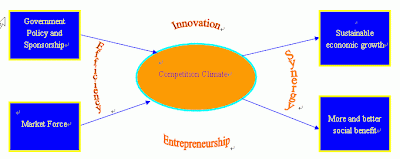
The benign competition climate is the set of factors spurring efficiency, stimulating innovation, spawning entrepreneurship and building synergy. Market force and government policies and sponsorship are two inputs that shape the benign competition climate.
Under current situation in the Europe, there is one illusion that treats the globalization and competition as the specters threatening European societies. However, regressing to heavy-handed state intervention and protectionism in order to fend off global competition would doom to be a failure. In the contrast, globalization is a win-win game instead of a win-lose game. An open and competitive market within a globalizing economy is able to deliver growth in one part of the world and simultaneously creates a wave of opportunities elsewhere too. Defensive action” – protectionism – would cut Europe off from the global market place it needs to engage to ensure economic growth and the sustainability of social models. To reach a high level of competitiveness Europe is required not only to focus on global competition, but also on competition inside the European Union and at national level. A competitive market will surely boost efficiency, encourage innovation, ensure long-term growth and raise the standards of living for everyone. Competition also makes companies strong and adaptable. So competition at home makes sure that businesses will also be able to successfully compete abroad.
Although it is widely accepted by the economists that markets are usually much better at allocating economic resources than government, orderly market conditions can not be established automatically. This is why smart government policies and sponsorship are crucial to make sure that the competition in the market place cranks out the expected outcome.
First of all, the policy should be competition-oriented. Government will support business entities that are willing to participate the competition regionally and internationally rather than provide solo economic shield that would only encroach on the efficiency and push up the price.
Second, the policy should aim at creating an atmosphere that promotes entrepreneurship in terms of financial aid, legal support and tax relief or exemption. As a very active element in the market, entrepreneurship makes great contribution to form a competition climate, drive economic growth and create quality jobs.
Third, government’ sponsorship should target on what is needed to revive Europe’s competitive edge. For example, government should grant financial back-up to company’s R&D activities in order to boost innovation.
Last but not the least important, European countries should build synergy that can leverage the whole Europe’s competition capability. To reap the maximum benefit from this end, a unitary competition policy aiming at enhancing the European’s competency should be adopted and honored by every European country. When the synergy is gained, the full potential of Europe will be unlocked and Europe will become much stronger in the global market. This conclusion can be further proved by a recent OECD study (Title: “The Benefits of Liberalising Product Markets”[1]), which suggests that aligning the different European national economic policies with the most competition friendly regimes would result in huge benefits for the European economy overall: a 2 to 3,5 % growth in GDP per capita.
Nevertheless, this is quite a challenging task for all the Europe countries. Although EU has achieved single currency and single market, the diversity of the member countries is still large. Not mention the other countries out of EU, which are still far behind the EU countries. The divergence inevitably creates the parochialism. It is tempting for individual country to deviate from a collective agreement with the purpose of addressing domestic political and economical agendas. However, this kind of economic patriotism twist the market force’s efficiency to allocates economic resource. In the short run, some industries might fend off the competition by the inappropriate government subsidization, but in the long run, these industries will become vulnerable or even terminated when the external competition force overtake the protection of the government.
If the competition climate could be established correctly, it would become the corner stone to elevate efficiency, stimulate entrepreneurship and encourage companies to innovate. The benign competition climate will incubate two desired outputs, the sustainable economic development and the better social benefit for every European citizen.
Competing Mentality.
Europe is facing great challenge internally and externally. If competition is the weapon to battle with this challenge, the people who will fight this war must be trained to use this weapon artfully.
Mentality is the attitude of mind or the way of thinking. Government policies and market force can create the hardware of the competition climate. But without the competing mentality to follow, the system will go nowhere without the right mentality working as the software. Especially under current circumstance, globalization and competition are not popular in European’s dictionary. Re-shaping people’s perception toward competition is also an indispensable step to form the benign competition climate.
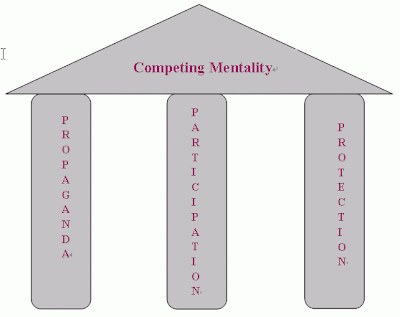
To shape competing mentality, three pillars must be planted. The three pillars are Propaganda, Participation and Protection.
Propaganda
Mentality is a mindset, it can not be taught, but can be motivated. A thorough propaganda to extol the competing mentality should be launched across the Europe continent in order to increase people’s awareness to the sustainable benefit driven by the competition at the local level and global level. The idea must be made crystal clear, the benefits of competitiveness, growth and lasting social and environmental development are mutually reinforcing rather than unilaterally debilitating under a global competition context. The exposure also need extend to the next generation, from the child to the youth, they are the future of Europe and they should know what is ahead of them and what they should prepare for.
Participation.
Both top-down and bottom-up methodology should be applied to build a competing mentality. Through top-down, all the European government, European Commission, local administrations and other public organizations need to permeate the concept of competition in their polices, regulations and statute. All the administrators should be proactively engaged in the promotion for the competition. EU plays an extremely role in this process because it represents the most influential parts of the Europe and it is the light house that guides the route of all European countries. It also has its authoritative and political power to make things happen.
Through bottom-up, the engagement of all the European citizens and private sectors is pivotal too. What they demand, concern and support determines whether this dynamic change can be successful. Their voice must be heard and heard clearly. If and only if their participation became active, the adversity occurring along the way of moving forward could be understood and accepted because the people who play the game also make the game rules.
Protection
Protection seems to be on the opposite side of competition. Whereas here the protection is at the social dimension rather than at the economic dimension. Out of the question, competition will bring long-run benefit to the whole Europe. But we have to keep in mind that those benefits will not be evenly distributed across the society. Competition do make winner and losers. The bankruptcy, unemployment and even poverty will still exist for a long period of time under the competitive business environment. They are the prices that have to pay and they will level off when the benign competition climate fully forms and functions. However, the solace offered by government and other institutions is still critical to maintain the social security and stability which are essential to maintain a friendly business environment. Besides, the protection also shoulders another very important responsibility of re-training the European workforce so they can fit in a knowledge-based economy and become more competitive. As a matter of fact, this would be the utmost protection for the European people.
Conclusion
Europe has prodigious potential. The enlargement of EU continues and the integration of the Europe accelerates. The 500 million people are invaluable assets, holding world-class skills and innovation capabilities. But Europe has not achieved the supernova performance commensurate with its abilities not only because of the ailing economic framework but also due to the low spirit and tumbling confidence. To unleash Europe’s enormous potential and rejuvenate its glory, a competition strategy and a dose of inspiration are necessary. In 14th century, Europe germinated the renaissance that brought immense impact on civilization and human history. In 21th century, I believe that a united Europe and its inspirational people will thrive again on the crest of the globalization wave and become the role model for the rest of the world. An inspired Europe will also inspire the world.
How to get the Europe back to the right track and achieve the goal set by Lisbon Strategy which aims to turn EU into the most competitive and dynamic knowledge based economy in the world? The answer lies on the creation of a unitary competition climate by each individual Europe country and the competing mentality held by most European people.
Upfront Challenge
Economic activity slows down in the Europe area, the employment rate is sagging and the business environment is getting worse steadily. In addition, each country holds different priority and political agendas, consequently the breach of multilateral agreements and pacts is stepping up, which leads to the intense friction between countries.
Europe also falls consistently behind the U.S.A. with approximate 2% lag over a long period time. Globalization brings competitive pressures not only on labor intensive industrial sectors but also on high-value and high-tech sectors. Moreover, the ageing European population also poses potential risk that would cripple the social security systems.
It is an urgency to inject the necessary dynamism and inspiration into Europe and its people in order to make European industry more competitive vis-à-vis its major global competitors.
Create benign competition climate
The benign competition climate is the set of factors spurring efficiency, stimulating innovation, spawning entrepreneurship and building synergy. Market force and government policies and sponsorship are two inputs that shape the benign competition climate.
Under current situation in the Europe, there is one illusion that treats the globalization and competition as the specters threatening European societies. However, regressing to heavy-handed state intervention and protectionism in order to fend off global competition would doom to be a failure. In the contrast, globalization is a win-win game instead of a win-lose game. An open and competitive market within a globalizing economy is able to deliver growth in one part of the world and simultaneously creates a wave of opportunities elsewhere too. Defensive action” – protectionism – would cut Europe off from the global market place it needs to engage to ensure economic growth and the sustainability of social models. To reach a high level of competitiveness Europe is required not only to focus on global competition, but also on competition inside the European Union and at national level. A competitive market will surely boost efficiency, encourage innovation, ensure long-term growth and raise the standards of living for everyone. Competition also makes companies strong and adaptable. So competition at home makes sure that businesses will also be able to successfully compete abroad.
Although it is widely accepted by the economists that markets are usually much better at allocating economic resources than government, orderly market conditions can not be established automatically. This is why smart government policies and sponsorship are crucial to make sure that the competition in the market place cranks out the expected outcome.
First of all, the policy should be competition-oriented. Government will support business entities that are willing to participate the competition regionally and internationally rather than provide solo economic shield that would only encroach on the efficiency and push up the price.
Second, the policy should aim at creating an atmosphere that promotes entrepreneurship in terms of financial aid, legal support and tax relief or exemption. As a very active element in the market, entrepreneurship makes great contribution to form a competition climate, drive economic growth and create quality jobs.
Third, government’ sponsorship should target on what is needed to revive Europe’s competitive edge. For example, government should grant financial back-up to company’s R&D activities in order to boost innovation.
Last but not the least important, European countries should build synergy that can leverage the whole Europe’s competition capability. To reap the maximum benefit from this end, a unitary competition policy aiming at enhancing the European’s competency should be adopted and honored by every European country. When the synergy is gained, the full potential of Europe will be unlocked and Europe will become much stronger in the global market. This conclusion can be further proved by a recent OECD study (Title: “The Benefits of Liberalising Product Markets”[1]), which suggests that aligning the different European national economic policies with the most competition friendly regimes would result in huge benefits for the European economy overall: a 2 to 3,5 % growth in GDP per capita.
Nevertheless, this is quite a challenging task for all the Europe countries. Although EU has achieved single currency and single market, the diversity of the member countries is still large. Not mention the other countries out of EU, which are still far behind the EU countries. The divergence inevitably creates the parochialism. It is tempting for individual country to deviate from a collective agreement with the purpose of addressing domestic political and economical agendas. However, this kind of economic patriotism twist the market force’s efficiency to allocates economic resource. In the short run, some industries might fend off the competition by the inappropriate government subsidization, but in the long run, these industries will become vulnerable or even terminated when the external competition force overtake the protection of the government.
If the competition climate could be established correctly, it would become the corner stone to elevate efficiency, stimulate entrepreneurship and encourage companies to innovate. The benign competition climate will incubate two desired outputs, the sustainable economic development and the better social benefit for every European citizen.

Competing Mentality.
Europe is facing great challenge internally and externally. If competition is the weapon to battle with this challenge, the people who will fight this war must be trained to use this weapon artfully.
Mentality is the attitude of mind or the way of thinking. Government policies and market force can create the hardware of the competition climate. But without the competing mentality to follow, the system will go nowhere without the right mentality working as the software. Especially under current circumstance, globalization and competition are not popular in European’s dictionary. Re-shaping people’s perception toward competition is also an indispensable step to form the benign competition climate.
To shape competing mentality, three pillars must be planted. The three pillars are Propaganda, Participation and Protection.

Propaganda
Mentality is a mindset, it can not be taught, but can be motivated. A thorough propaganda to extol the competing mentality should be launched across the Europe continent in order to increase people’s awareness to the sustainable benefit driven by the competition at the local level and global level. The idea must be made crystal clear, the benefits of competitiveness, growth and lasting social and environmental development are mutually reinforcing rather than unilaterally debilitating under a global competition context. The exposure also need extend to the next generation, from the child to the youth, they are the future of Europe and they should know what is ahead of them and what they should prepare for.
Participation.
Both top-down and bottom-up methodology should be applied to build a competing mentality. Through top-down, all the European government, European Commission, local administrations and other public organizations need to permeate the concept of competition in their polices, regulations and statute. All the administrators should be proactively engaged in the promotion for the competition. EU plays an extremely role in this process because it represents the most influential parts of the Europe and it is the light house that guides the route of all European countries. It also has its authoritative and political power to make things happen.
Through bottom-up, the engagement of all the European citizens and private sectors is pivotal too. What they demand, concern and support determines whether this dynamic change can be successful. Their voice must be heard and heard clearly. If and only if their participation became active, the adversity occurring along the way of moving forward could be understood and accepted because the people who play the game also make the game rules.
Protection
Protection seems to be on the opposite side of competition. Whereas here the protection is at the social dimension rather than at the economic dimension. Out of the question, competition will bring long-run benefit to the whole Europe. But we have to keep in mind that those benefits will not be evenly distributed across the society. Competition do make winner and losers. The bankruptcy, unemployment and even poverty will still exist for a long period of time under the competitive business environment. They are the prices that have to pay and they will level off when the benign competition climate fully forms and functions. However, the solace offered by government and other institutions is still critical to maintain the social security and stability which are essential to maintain a friendly business environment. Besides, the protection also shoulders another very important responsibility of re-training the European workforce so they can fit in a knowledge-based economy and become more competitive. As a matter of fact, this would be the utmost protection for the European people.
Conclusion
Europe has prodigious potential. The enlargement of EU continues and the integration of the Europe accelerates. The 500 million people are invaluable assets, holding world-class skills and innovation capabilities. But Europe has not achieved the supernova performance commensurate with its abilities not only because of the ailing economic framework but also due to the low spirit and tumbling confidence. To unleash Europe’s enormous potential and rejuvenate its glory, a competition strategy and a dose of inspiration are necessary. In 14th century, Europe germinated the renaissance that brought immense impact on civilization and human history. In 21th century, I believe that a united Europe and its inspirational people will thrive again on the crest of the globalization wave and become the role model for the rest of the world. An inspired Europe will also inspire the world.
Subscribe to:
Posts (Atom)